
What Is NQ? A Beginner's Guide to Nasdaq 100 Futures
If you've heard traders talk about NQ, they're talking about Nasdaq 100 futures. It's one of the most liquid and widely traded futures contracts in the world — and it's the only instrument LSTrades uses.
Here's everything you need to know to understand what NQ is and why it matters.
What NQ Actually Is
NQ is the ticker symbol for the E-mini Nasdaq 100 futures contract, traded on the Chicago Mercantile Exchange (CME). It tracks the Nasdaq 100 index — a basket of the 100 largest non-financial companies listed on the Nasdaq stock exchange.
That basket includes names like Apple, Microsoft, Nvidia, Amazon, Meta, and Alphabet. When those companies move, NQ moves with them.
The "E-mini" part means it's an electronically traded contract sized at 1/5th of the original full-size Nasdaq 100 contract. It was designed to make the market accessible without requiring massive capital.
How the Contract Is Priced
NQ is quoted in points. Each full point in NQ equals $20 in profit or loss per contract.
That might sound abstract, so here's a concrete example:
- You buy 1 NQ contract at 19,500
- Price moves up to 19,520
- That's 20 points × $20 = $400 profit
If price moved against you by 20 points instead, you'd be down $400 per contract. This is why position sizing and stop loss placement matter — a standard NQ trade can move hundreds of dollars in seconds.
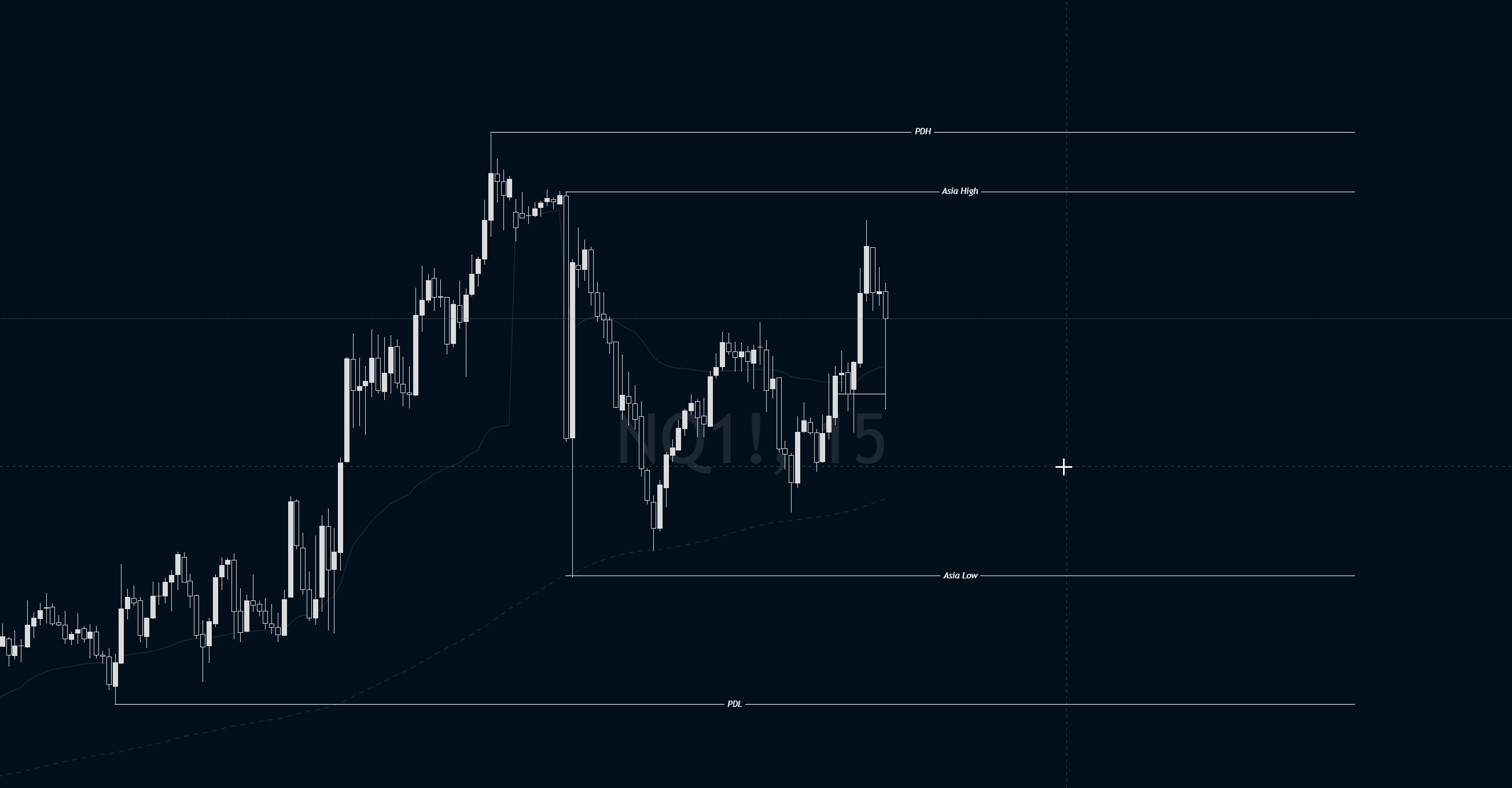
For smaller accounts, the Micro E-mini (MNQ) offers the same market at 1/10th the size — $2 per point instead of $20.
| Contract | Ticker | Value Per Point | |----------|--------|----------------| | E-mini Nasdaq 100 | NQ | $20 | | Micro E-mini Nasdaq 100 | MNQ | $2 |
How NQ Differs from Trading Stocks or ETFs
When you buy a stock, you own a share of a company. When you trade NQ futures, you're trading a contract that tracks an index. There are several key differences:
Leverage is built in. To control one NQ contract, you don't need to fund the full notional value (around $400,000 at current levels). A brokerage will require a margin deposit — typically $1,000–$2,000 for day trading, depending on the broker. This leverage cuts both ways: profits scale up, and so do losses.
The market is nearly 24 hours. NQ futures trade Sunday through Friday with only a brief maintenance break. This means price is moving before the US stock market opens and after it closes. Overnight gaps, pre-market moves, and off-hours reactions to news all show up on the NQ chart.
No PDT rule. The Pattern Day Trader rule — which limits certain US stock traders to 3 day trades per week in accounts under $25,000 — does not apply to futures. NQ traders can take multiple trades per day regardless of account size.
Tax treatment differs. In the US, futures contracts typically receive 60/40 tax treatment (60% long-term, 40% short-term capital gains) regardless of holding period. This is more favorable than short-term stock gains for most traders. Consult a tax professional for your specific situation.
Why NQ Specifically
LSTrades uses NQ exclusively. Here's the reasoning:
Volatility is predictable. NQ moves enough in a single session to produce clean, tradeable swings — but it follows patterns. The liquidity sweep and iFVG entry model work because institutional order flow in NQ is large, consistent, and leaves visible footprints on the chart.
Volume is massive. High volume means tight spreads, minimal slippage, and clean technical levels. When NQ sweeps a prior high, it's a real event driven by real orders — not a thin-market anomaly.
The NY AM session is ideal. NQ comes alive when the US equity market opens at 9:30 AM EST. The first two hours after the open (the window LSTrades focuses on) produce the cleanest setups because institutional participation peaks during that window.
One market, one methodology. Jumping between ES, YM, crude oil, and gold requires you to understand multiple market structures and order flow patterns simultaneously. NQ's behavior during the NY AM session is consistent enough to build a repeatable, rules-based system around it.
What NQ1! Means
If you've seen the ticker NQ1! on TradingView, that's the continuous futures contract — it automatically rolls to the next active contract so you get an uninterrupted chart history. It's what LSTrades runs the indicator on.
Futures contracts expire quarterly (March, June, September, December). As expiration approaches, volume migrates to the next contract. The ! notation on TradingView handles this rollover for you.
The Relationship Between NQ and QQQ
QQQ is the Invesco ETF that tracks the same Nasdaq 100 index. Some traders use QQQ as a reference, but trading QQQ and trading NQ futures are different activities.
QQQ is an equity and subject to PDT rules. It has no built-in leverage, a different tax treatment, and trades only during stock market hours. NQ gives you leveraged exposure to the same index with more flexibility — at the cost of higher risk.
Risk Is Real
Because NQ uses margin and moves quickly, losses can exceed deposits if positions aren't managed. The LSTrades system uses defined stop losses on every trade — not because stops guarantee safety, but because trading without defined risk management in NQ is a fast path to significant loss.
Every alert in the LSTrades system includes a stop loss level. That level exists for a reason.
Trading futures involves substantial risk and is not appropriate for all investors. Past results do not guarantee future performance.
Next Steps
If you're new to NQ, the best starting point is understanding the NY AM session — the specific window where LSTrades signals fire. NQ Futures Session Times breaks down what happens in each session and why the 9:45–11:00 AM EST signal window produces the cleanest setups.
From there, What Is a Liquidity Sweep? covers the first step in the LSTrades signal sequence.
Want to see NQ trades in real-time? Join the LSTrades community on Discord — every signal fires with grade, entry, SL, and TP targets. Or see the full access tiers if you're ready to go further.
Want live signals?
Get A-graded NQ setups delivered to Discord in real-time.
Every signal includes entry, stop loss, and two take-profit targets. No screen time required.