
NQ Futures Session Times: When to Trade NAS100
Futures markets trade nearly 24 hours a day, 5 days a week. But if you're trading NQ (Nasdaq 100 futures), most of those hours don't matter.
The difference between a profitable NQ trader and a frustrated one often comes down to one thing: knowing which hours to trade and which to ignore.
Here's the full breakdown of NQ session times, what happens in each window, and why one specific session produces the majority of high-probability setups.
The Sessions
NQ futures follow a global clock. Each session reflects when a major financial center is active:
| Session | Time (EST) | What Happens | |---------|-----------|--------------| | Asia | 8:00 PM – 12:00 AM | Quiet. Low volume. Ranges build. | | London | 2:00 AM – 5:00 AM | Moderate activity. Fake moves and early liquidity grabs. | | NY AM | 8:30 AM – 11:30 AM | Peak volume. US equities open. The action window. | | NY Lunch | 12:00 PM – 1:00 PM | Consolidation. Volume drops. Avoid. | | NY PM | 1:30 PM – 4:00 PM | Second wind. Institutional repositioning. |
These times are in Eastern Standard Time (EST). The LSTrades indicator tracks all five sessions and draws colored boxes on the chart so you can see session boundaries at a glance.
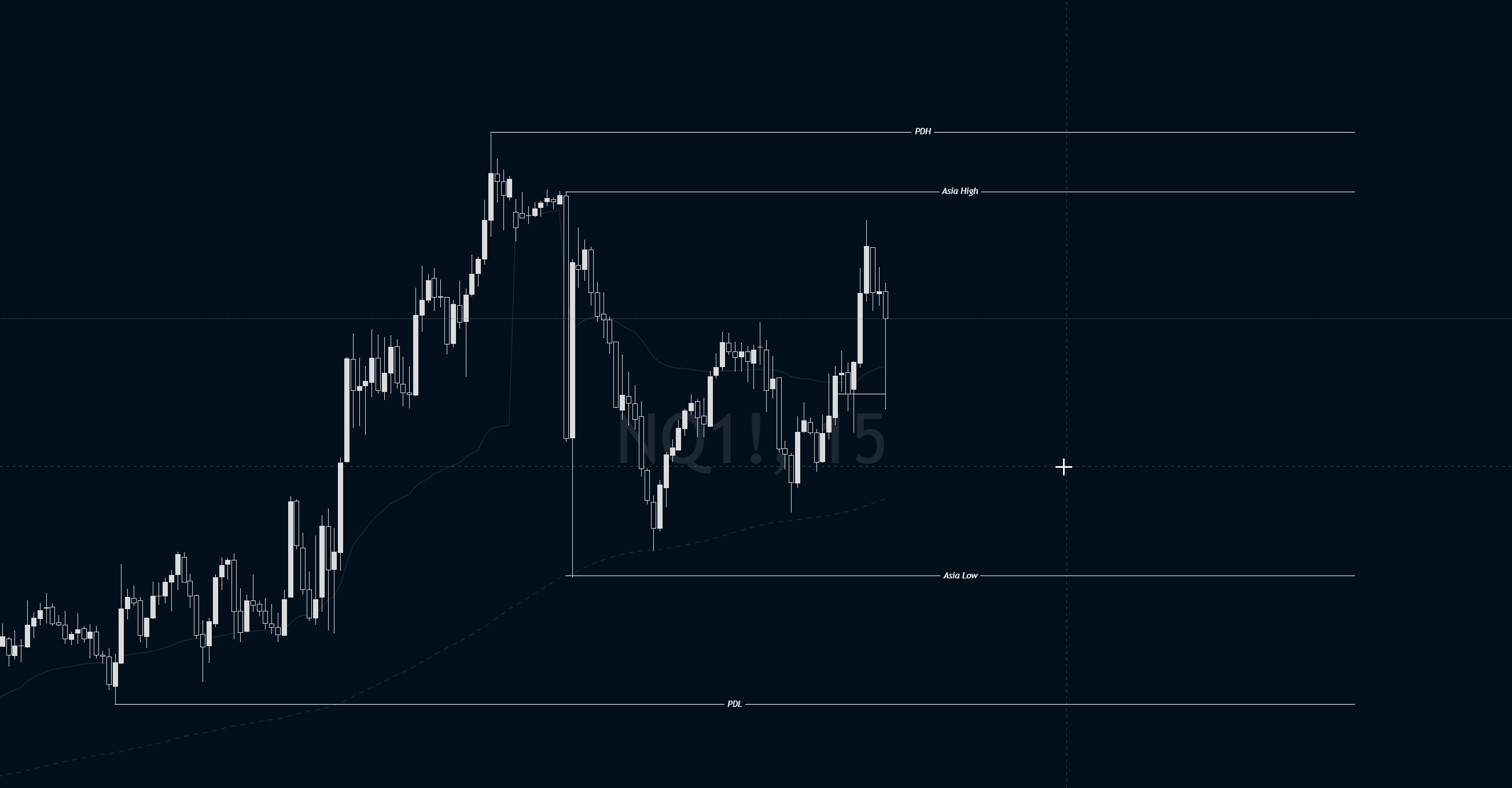
Why the NY AM Session Matters Most
The NY AM session (8:30 – 11:30 AM EST) is when NQ comes alive. US equities open at 9:30 AM, institutional desks are fully staffed, and the volume required for clean price action is present.
Here's what makes this window special for NQ specifically:
Institutional order flow peaks. The largest participants in NQ futures — hedge funds, prop firms, market makers — execute the bulk of their positioning during the first two hours after the US equity open. This creates the displacement candles and sharp reversals that form clean setups.
Liquidity sweeps are cleanest. When institutions need to fill large orders, they drive price into pools of resting stops (at prior day highs/lows, overnight extremes, etc.). During the NY AM session, there's enough volume for these sweeps to execute fully and reverse — not chop around the level for hours.
Follow-through is highest. A reversal after a sweep during peak volume is more likely to reach its profit targets than the same pattern during Asia or London. The market has the participation to sustain directional moves.
This is why the LSTrades signal system concentrates on this window. Signals only fire during the session — no overnight alerts, no London session noise.
The Signal Window Within the Session
Within the broader NY AM session, there's an even more focused window where the LSTrades indicator fires signals: 9:45 – 11:00 AM EST.
Why this narrower window?
- Before 9:45, the US equity open (9:30) is still settling. The first 15 minutes produce a lot of noise as opening orders flush through. Waiting lets the initial chaos resolve.
- After 11:00, momentum fades and price action gets choppier as lunch hour approaches. The 11:00–11:30 segment is excluded by default for this reason.
- The 9:45–11:00 window captures the post-open liquidity grabs and the first major reversal — the highest-probability setup window of the day.
The indicator's trade timing window is configurable, but the 9:45–11:00 default is conservative by design — signal quality drops outside it.
What Each Session Produces
Asia (8:00 PM – 12:00 AM EST)
Asia session on NQ is typically low-volume consolidation. Price builds a range — and that range becomes a liquidity target for later sessions.
What to note: Mark the Asia session high and low. These levels are tracked by the LSTrades indicator as potential sweep targets. When the NY AM session opens, price frequently raids one of these levels before reversing.
London (2:00 AM – 5:00 AM EST)
London brings moderate volume and often produces the day's first liquidity grab. Price may sweep the Asia range high or low, setting up the directional bias for NY.
What to note: London session highs and lows are also tracked as liquidity levels. A London sweep of the Asia high, followed by a NY AM sweep back into the Asia low, is a classic NQ pattern.
NY AM (8:30 AM – 11:30 AM EST)
This is the session. Sweeps are decisive, reversals are clean, and setups that fire here have the highest probability of reaching their targets.
What to note: This is where the LSTrades indicator is designed to operate. All signal grading requires that the liquidity sweep happened during this session.
NY Lunch (12:00 PM – 1:00 PM EST)
Volume drops. Spreads widen on some instruments. Price chops. Professional traders largely step away during this window.
What to note: There's no edge here for most retail traders. The LSTrades system does not fire signals during lunch.
NY PM (1:30 PM – 4:00 PM EST)
A secondary activity window. Institutional repositioning and end-of-day flows can produce moves, but they're harder to anticipate and less consistent than the AM session.
What to note: The PM session's highs and lows become liquidity levels for the following day. The LSTrades indicator tracks NY PM pivots for this reason.
Session Levels as Liquidity Targets
Each session's high and low becomes a potential liquidity target for future sessions. The LSTrades indicator labels these on the chart:
- AS.H / AS.L — Asia session high and low
- LO.H / LO.L — London session high and low
- NYAM.H / NYAM.L — NY AM session high and low
- NYPM.H / NYPM.L — NY PM session high and low
- PDH / PDL — Previous Day High and Low
These levels are where stop-loss clusters form. When the NY AM session opens, the indicator watches for price to sweep one of these levels — and that sweep is the first gate for a valid signal.
The Session Trade Limit
The LSTrades system allows a maximum of 2 trades per session. If the first trade hits its full target (TP2), the session is considered complete and no second trade fires.
This isn't arbitrary. After the first clean setup in the NY AM window, the market's initial institutional positioning is largely done. Subsequent setups carry progressively lower edge. Two trades capture the best opportunities without overtrading.
Practical Takeaways
- Trade the NY AM session. If you can only watch one window, focus on 9:45 – 11:00 AM EST — the default signal window.
- Mark session levels before the open. Asia, London, and prior-day extremes are your liquidity map.
- Don't trade lunch. 12:00 – 1:00 PM is dead time on NQ.
- Let the automated system handle timing. The LSTrades indicator knows the session boundaries, tracks the levels, and only fires during the window with edge.
Understand the full signal logic: What Is a Liquidity Sweep? covers why sweeps matter, and What Is an iFVG? explains the entry trigger. Or join the free LSTrades Discord and watch sessions play out in real-time.
Want to sit in the room?
Trade NQ live with me every NY open.
Pre-market read, the entry called as price gets there, full debrief after. You watch the read, not just the result.