
What Is CISD in ICT Trading? (Change in State of Delivery Explained)
If you've spent any time in ICT trading circles, you've seen the term CISD thrown around. It sounds technical. It is — but the concept behind it is straightforward once you see it on a chart.
CISD stands for Change in State of Delivery. It's the market's way of confirming that the directional bias has shifted. Not a guess. Not a prediction. A structural confirmation.
Here's what it actually means and how the LSTrades system uses it.
The Core Idea
Every market is either delivering price higher or delivering price lower. That's the "state of delivery."
A CISD happens when price confirms it has changed direction by closing through a significant swing level. Specifically:
- Bullish CISD: Price closes above the body (not wick) of a prior swing high → delivery has shifted from bearish to bullish
- Bearish CISD: Price closes below the body of a prior swing low → delivery has shifted from bullish to bearish
The emphasis on candle body close is important. A wick through a swing level doesn't count. The market needs to commit — a full body close through the level — before the CISD is valid.
CISD vs CHoCH — Are They the Same?
In practice, yes. CISD and CHoCH (Change of Character) describe the same structural event: price closing through a swing point in the opposite direction.
Different educators use different terms for the same concept. The LSTrades system uses "CISD" because it's the term used in the ICT framework, but if you've learned CHoCH elsewhere, you're looking at the same thing.
How to Spot a CISD on NQ
On a 5-minute NQ chart:
-
Identify the swing points. Look for clear pivot highs and pivot lows — points where price reversed direction. These should be obvious, not micro-swings.
-
Wait for a body close through a swing. If price has been making lower lows and lower highs (bearish delivery), watch for a candle that closes its body above a recent swing high. That close is the CISD.
-
The swing body matters, not the wick. The level you're measuring against is the open/close of the swing candle, not its high or low. And the confirming candle must also close (not just wick) through that level.
Here's the visual sequence for a bullish CISD:
- Price sweeps a low (takes liquidity)
- A strong reversal begins
- Price pushes up toward a recent swing high
- A candle closes its body above that swing high's body
- CISD confirmed — delivery has changed from bearish to bullish
The LSTrades indicator draws a horizontal line from the swing body level to the confirming candle, labeled "CISD" at the midpoint.
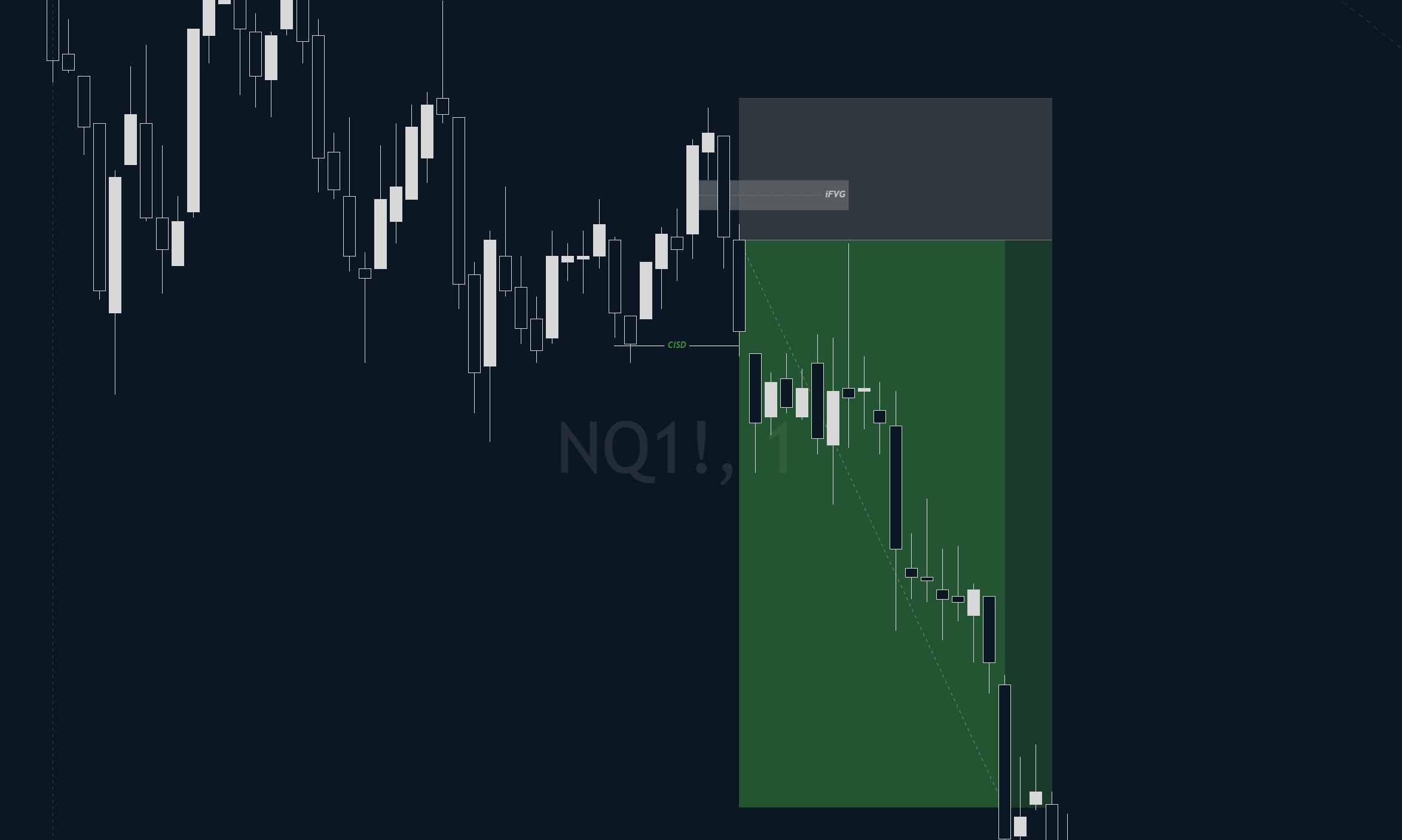
Why CISD Matters for Trading
A CISD tells you something that price action alone can be ambiguous about: the market has committed to a new direction.
Without structural confirmation, a bounce off a low might just be a retracement before the next leg down. With a CISD, the market has proven — by closing through a swing level — that the prior trend structure is broken.
This is why the LSTrades system uses CISD as a confluence factor, not a standalone signal. It doesn't tell you when to enter. It tells you whether the structural environment supports the trade direction.
How LSTrades Uses CISD
In the LSTrades grading system, CISD is checked on the 5-minute timeframe regardless of what chart timeframe you're running the indicator on. This ensures consistent structure detection.
CISD contributes to the grade in two ways:
As a confluence factor for reversal trades: When a signal fires after a liquidity sweep + iFVG inversion, the presence of a 5-minute CISD in the trade direction adds confidence. It's one of the factors that can upgrade a signal from A to A+.
As the foundation for continuation trades: The continuation model (CONT) requires a prior CISD in the trade direction. If the market established a bullish CISD, then pulls back and presents a new iFVG in the same direction, that's a continuation setup. The CISD tells you the structural bias hasn't changed — you're trading with the confirmed trend, not against it.
CISD and the Grading System
Here's how CISD fits into the signal grading:
| Grade | Role of CISD | |-------|-------------| | A | Not required — base conditions are sweep + iFVG in the NY AM session | | A+ | CISD is one of the factors that can upgrade to A+ (alongside BPR and HTF FVG) | | A++ | CISD typically present as part of full multi-timeframe alignment |
A signal doesn't need CISD to be valid. But its presence means the market structure supports the trade direction — and that's reflected in a higher grade.
What CISD Is Not
It's not an entry signal. CISD confirms direction, not timing. The iFVG inversion is the entry mechanism.
It's not the same as a breakout. A breakout trader might buy when price closes above a swing high. CISD says the structure has changed, but the LSTrades system still waits for a sweep + iFVG before entering.
It's not permanent. A bullish CISD remains valid until price creates a bearish CISD (closes below a swing low body). Structure can flip multiple times in a session.
The Bigger Picture
CISD is one layer in a multi-layered system:
- Liquidity sweep → institutions took orders at a key level
- iFVG inversion → price created and re-entered an imbalance (the entry trigger)
- CISD → structural confirmation that delivery direction has changed
- HTF FVG alignment → the sweep happened into a higher-timeframe imbalance zone
- MTF trend agreement → 4H, 1H, 15m, and 5m all agree on direction
The more of these layers that align, the higher the grade. CISD sits at layer 3 — it's the structural backbone that tells you whether the market agrees with your trade.
Learn the entry mechanism: What Is an iFVG? Or start with the foundation: What Is a Liquidity Sweep?. Ready to see CISD in action? Join the free Discord community and watch confluence factors fire on live signals.
Want to sit in the room?
Trade NQ live with me every NY open.
Pre-market read, the entry called as price gets there, full debrief after. You watch the read, not just the result.