
Top-Down Analysis: How to Read HTF Trend Before Dropping to LTF
Every LSTrades signal starts before the 5-minute chart. It starts on the 15-minute, 1-hour, or 4-hour chart — the higher timeframes (HTF) that show you where the larger money is positioned.
This process is called top-down analysis. It's not optional. It's the first step of the methodology.
What Top-Down Analysis Means
Top-down analysis means reading the market from high timeframe to low timeframe, in that order. You establish context at the macro level first, then zoom into the execution timeframe to find your entry.
The logic is straightforward: a 5-minute chart can show you a clean-looking reversal setup. But if that 5-minute reversal is fighting against a 1-hour bullish trend, you're taking a counter-trend trade with the wind in your face. Top-down analysis stops that from happening.
In LSTrades, the process looks like this:
- Read the HTF trend (15m, 1H, or 4H) — determine whether the market is in a bullish or bearish structure
- Identify HTF imbalances — mark Fair Value Gaps on those higher timeframes; these become high-probability reversal zones
- Drop to 5-minute — wait for a liquidity sweep and iFVG inversion that aligns with HTF context
- Enter with confirmation — the entry is on the low timeframe (LTF), but it's backed by HTF reasoning
What Higher Timeframes Tell You
The HTF chart tells you three things:
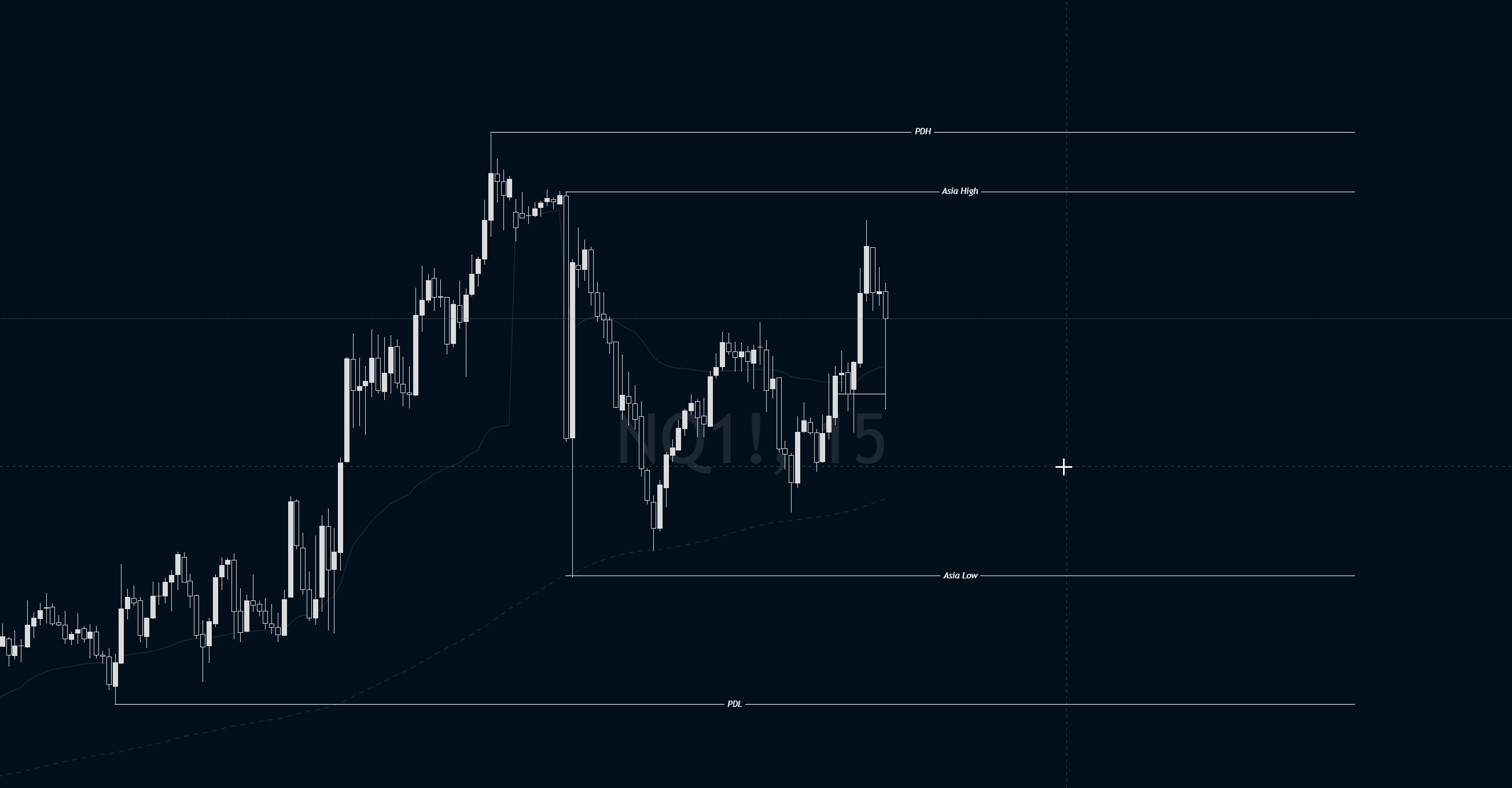
Trend direction. Is price making higher highs and higher lows (bullish)? Or lower highs and lower lows (bearish)? The dominant structure on the 1-hour chart is the bias you trade with on the 5-minute chart. Going counter-trend is possible but requires additional confluence.
Where imbalances exist. An HTF Fair Value Gap (FVG) on the 15-minute, 1-hour, or 4-hour chart is significant. These zones represent price moving too quickly for the market to fully process at that timeframe — and they're magnets. Price tends to return to fill those imbalances.
Where liquidity sits. Every prior swing high and swing low on the HTF chart is a liquidity pool. Traders place stops above highs and below lows. Institutions need to sweep that liquidity to fill their orders. Identifying those pools on the 1-hour chart tells you where the next sweep is likely to happen.
The Three Relevant Higher Timeframes
The LSTrades methodology references three HTF levels:
| Timeframe | What It Shows | How It's Used | |-----------|--------------|----------------| | 15-minute | Recent structure, session-level FVGs | Closest to the entry; most relevant for same-day context | | 1-hour | Daily trend structure, major FVGs | Primary reference for trend bias | | 4-hour | Macro trend, institutional positioning | Context for major reversals and weekly bias |
For daily NY AM session trading, the 15-minute and 1-hour are the primary references. The 4-hour matters more for understanding whether you're in a trending week or a ranging one.
Why HTF FVGs Matter for Grading
When the LSTrades indicator assigns a grade of A+ or A++ to a signal, one of the factors it evaluates is whether the sweep happened near an HTF FVG.
Here's why that's significant:
A 5-minute iFVG entry is strong on its own — sweep happened, imbalance created, iFVG inverting. But if that sweep and reversal is happening at the exact location of a 15-minute or 1-hour Fair Value Gap, you have alignment across two timeframes. The HTF imbalance provides a reason for the reversal beyond just the 5-minute pattern.
This is what the Reversal Model 1 (RM1) setup specifically requires: a sweep, an HTF FVG alignment, and an iFVG on the 5-minute. When all three are present, the grade is automatically A+ or higher.
The LTF Execution Layer
Once HTF context is established, you drop to the 5-minute chart for execution. This is the low timeframe (LTF) where:
- The liquidity sweep happens (price takes out a swing high or low)
- The reversal candle creates an FVG
- Price retraces into that FVG, inverting it
- The iFVG inversion is the entry signal
The LTF gives you precision. The HTF gives you conviction. A setup with both is significantly more reliable than one derived from a single timeframe.
Common Mistake: Trading LTF Without HTF Context
The most common error in NQ trading is seeing a clean 5-minute setup and entering without checking the higher timeframes.
What happens:
- A 5-minute iFVG setup appears
- Trader enters long
- Price hits TP1, then stalls
- 15-minute chart shows a massive bearish FVG directly overhead
- Price reverses before TP2, potentially stopping out the trade
The 5-minute signal was technically valid. But the 15-minute context made it a lower-probability trade. A top-down review before entry would have caught that overhead resistance.
Practical Application
Here's a simplified pre-trade checklist before entering any NQ setup:
- Check the 1-hour chart. Is price in a bullish or bearish structure?
- Mark any 1-hour FVGs. Is price sitting near one? Is the setup aligning with it or fighting it?
- Mark HTF highs and lows. Where is the liquidity above and below?
- Check the 15-minute. Any nearby FVGs that could act as magnets or resistance?
- Drop to 5-minute. Has the sweep occurred? Is the iFVG inverting? Does the direction match the HTF bias?
If the LTF setup aligns with HTF context, you have a higher-probability trade. If it doesn't, the grade will reflect that — and you might decide to skip it or size down.
How This Connects to Signal Models
Top-down analysis isn't separate from the LSTrades signal system — it's built into it. The three entry models (RM1, RM2, and CONT) each represent a different combination of HTF context and LTF execution:
- RM1 requires explicit HTF FVG alignment — highest HTF confluence
- RM2 fires without HTF FVG but still requires the sweep — HTF structure matters
- CONT trades in the direction of the established trend — HTF bias is the prerequisite
These models are explained in full in The Reversal Models: RM1 and RM2 Explained and The Continuation Model.
Understanding the full signal sequence: What Is a Liquidity Sweep? explains the first step, and What Is an iFVG? covers the entry trigger. Or join the free Discord and watch top-down context play out in real-time.
Want live signals?
Get A-graded NQ setups delivered to Discord in real-time.
Every signal includes entry, stop loss, and two take-profit targets. No screen time required.