
The journal — education
Stop Loss Placement in NQ Futures: Why Your SL Is Not Random
At some point early in my trading, I set a stop loss at "25 points below entry" because that felt like enough room. Not because of any structure, not because of where the market would prove me wrong — just because 25 points felt safe.
Price hit 24 points against me. Stopped out. Then reversed and went 80 points in my direction.
That experience wasn't bad luck. It was bad stop placement. And it's one of the most fixable problems in trading.
Why Arbitrary Dollar-Amount Stops Fail
An arbitrary stop — "I'll risk $200 on this trade" or "I always use a 20-point stop" — doesn't care about the market structure. It's placed based on what you're comfortable losing, not based on where the trade is invalidated.
The market doesn't know your dollar amount. Price will sweep liquidity where it's concentrated, trigger stops where they cluster, and reverse from structural levels. If your stop is placed at a round number or a fixed distance from entry, it sits in no-man's land relative to what the market is actually doing.
Structural stop placement changes the question from "how much can I afford to lose?" to "where does this trade idea stop making sense?" These are very different questions.
The Developing 3m Structure as SL Location
Every LS Model entry fires off a 3m trigger: price pulls back into the level — an unmitigated fair value gap or the last swing — rejects, and closes beyond the recent high or low in the trade's direction. The trade thesis is that the 3m structure which produced that close holds.
So that's where the stop goes: beyond the developing 3m structure. For a long, under the structure the move is building; for a short, above it.
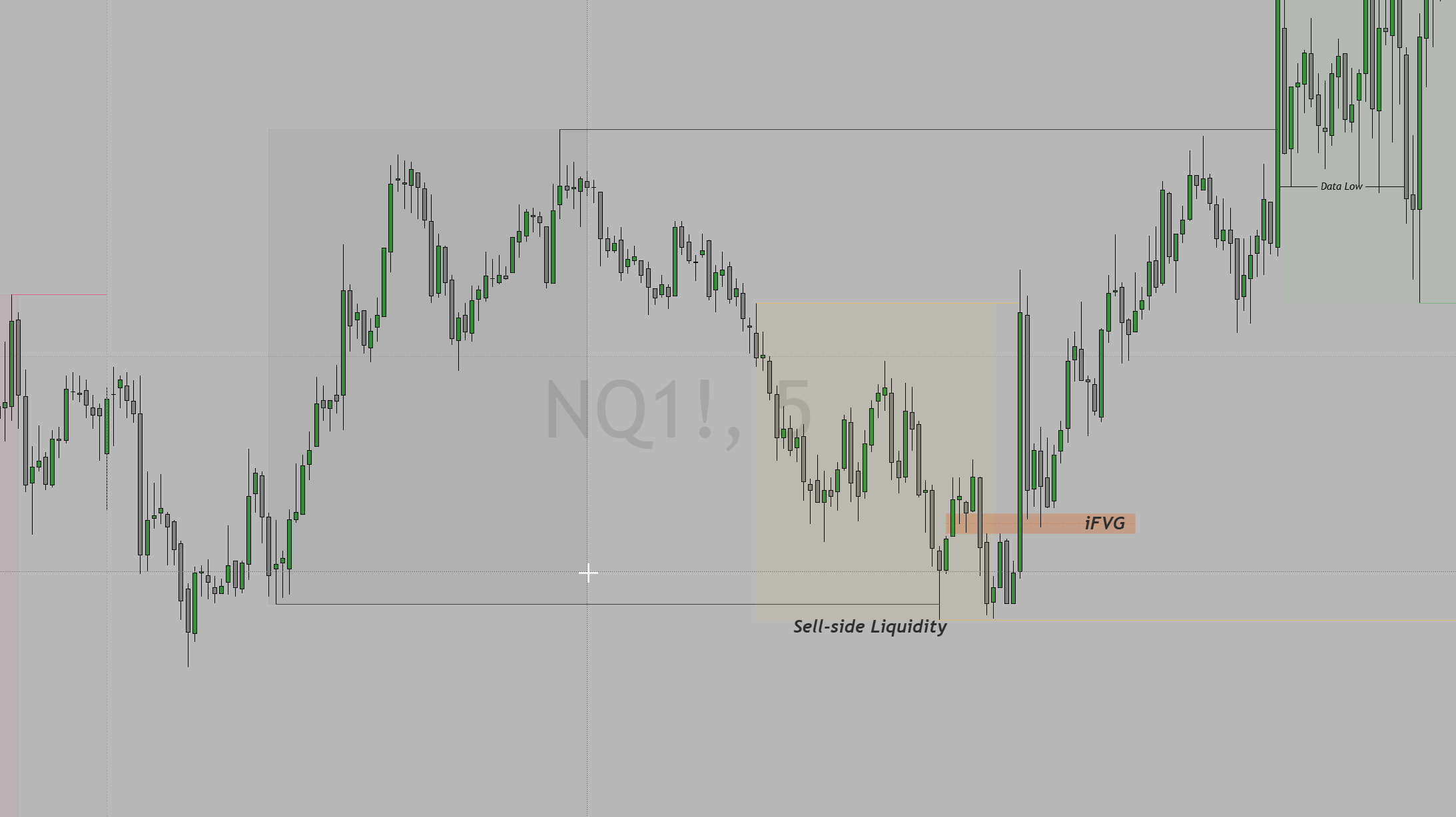
This isn't a mechanical rule applied blindly. It's a consequence of the trade logic. You entered because the 3m rejected and confirmed direction. If price breaks back through the structure that confirmation built, the trigger failed. The stop sits at the point of failure, not at an arbitrary distance from entry.
The same rule covers all three entry types — Continuation, Bias Flip, and Opening Drive. One stop logic, everywhere.
Why the SL Size Varies
Because the stop is placed at structure, not at a fixed distance, the SL in points will vary from trade to trade.
Tight 3m structure might produce a 10-point stop. A wider rejection might produce a 20-point stop. This is correct behavior. The market structure of each setup is different, and the stop should reflect that.
The stop size then does double duty: it defines 1R for the trade, and it filters the setup. The target is the next opposing pool of liquidity — and if that target doesn't clear the trade's risk-to-reward floor (1:2 minimum for a Continuation, ideally 1:3), the trade doesn't qualify at all. A stop that's too wide relative to the available liquidity isn't a reason to shrink the stop. It's a reason to skip the trade.
Breakeven at 1:1, Then the Trail
Management after entry is fixed:
- At 1:1 — the stop moves to breakeven. From here the trade cannot lose.
- After breakeven — the stop trails the developing 3m structure as price works toward the target.
- At the liquidity target — the position closes in full. One exit, no partials.
Why there's no TP1/TP2 ladder anymore is its own post: Why the LS Model Exits Once.
Don't Move Your Stop Loss
This is not optional advice.
Once a trade is live and the SL is placed at structure, it doesn't move — except to breakeven at 1:1, and then along the developing structure as the trade works. It doesn't move toward entry to "reduce risk" if the trade goes against you. It doesn't widen if price gets close.
The reason is simple: if you widen the stop because price approaches it, you're changing the trade thesis mid-trade. The original stop was placed where the trade idea would be proven wrong. If you move it because you don't want to be wrong, you're not managing risk — you're avoiding accountability to the plan.
Moving your stop away from you converts a defined-risk trade into an undefined-risk trade. You no longer know what you're risking. This is where "I'll move it just this once" turns into a 100-point stop on a position originally planned for 15 points.
If you're tempted to move the stop, ask: would I enter this trade fresh right now, with this new, wider stop? If the answer is no, the answer is to let it hit or hold the original.
What This Means for Position Sizing
If your SL varies by trade, and your risk per trade is constant, your position size needs to adjust.
The LS Model risks 1% per trade on evaluations and prop challenges, 0.5% on funded accounts. If that works out to $500 on this trade and your SL is 10 points, you're trading 5 contracts (at $100/point for NQ). If the SL is 20 points, you're trading 2.5 contracts for the same dollar risk.
This is the correct way to maintain consistent exposure: fix the percentage risk, let the position size float with the structural stop. Not the other way around.
Traders who fix their position size and let the dollar risk float end up taking much larger losses on wide-stop trades than narrow-stop trades — the opposite of what they intended.
Stop placement is one part of a complete trade plan. Read Why the LS Model Exits Once for the management from entry to close. And if you haven't read What Is a Bias Flip?, start there — it explains the reversal entry the stop is protecting.
Past results do not guarantee future performance. Trading NQ futures involves significant risk of loss.
Want to sit in the room?
Trade NQ live with me every NY open.
Pre-market read, the entry called as price gets there, full debrief after. You watch the read, not just the result.