
How to Identify a Liquidity Sweep on NAS100 (Step-by-Step)
You already know what a liquidity sweep is — price takes out resting orders at a key level and reverses. But recognizing one on a live NQ chart, in real-time, while the candle is printing? That's a different skill entirely.
This post breaks down exactly how to identify sweeps on NAS100 futures. Not in hindsight. Not on a textbook diagram. On a live chart, during the session that matters.
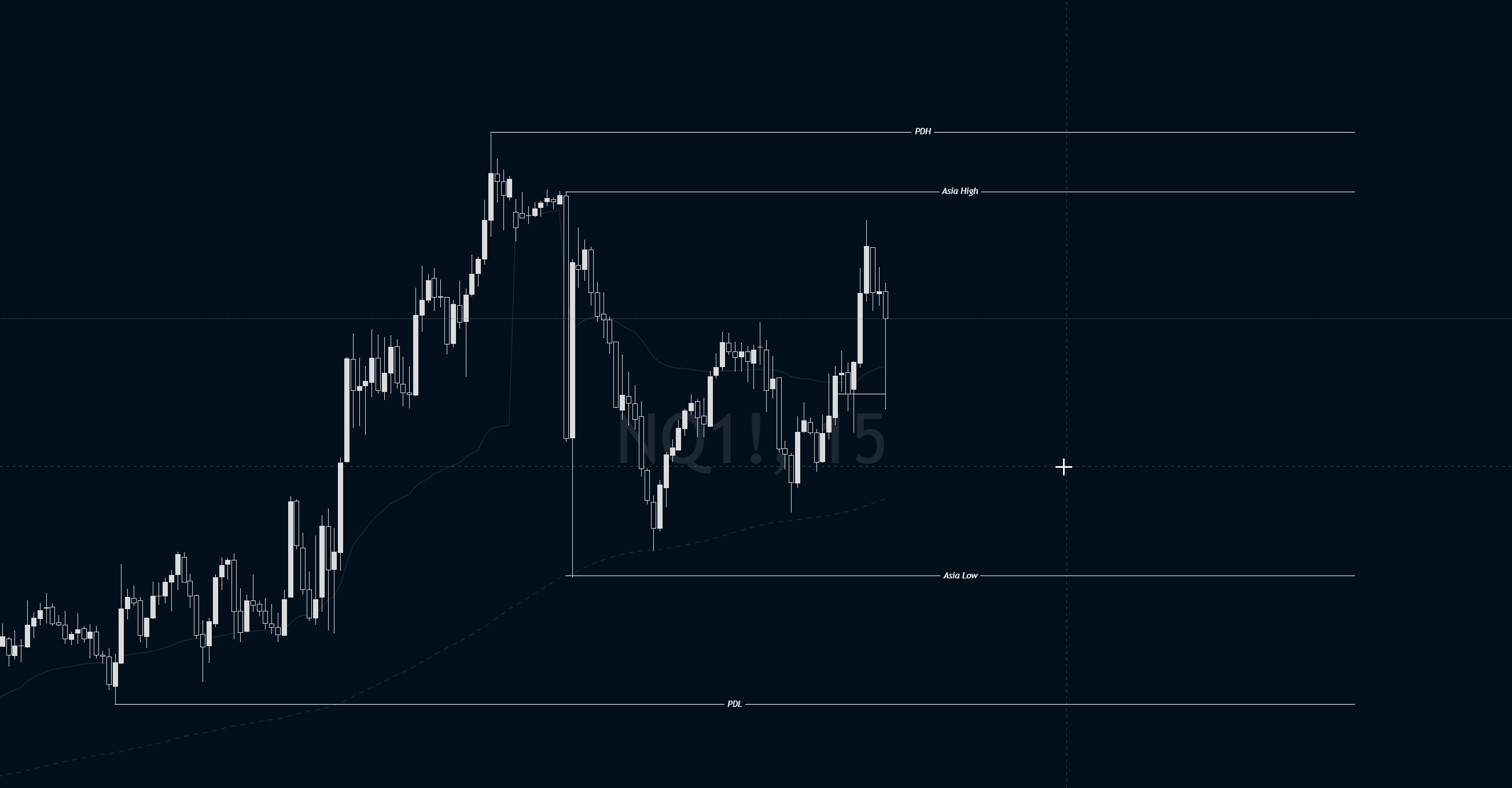
Step 1: Map the Liquidity Levels Before the Session
Before the 9:30 AM EST open, mark these levels on your chart:
- Previous Day High (PDH) and Previous Day Low (PDL) — the most common targets for NY AM sweeps
- Overnight High and Overnight Low — the range price built during Asia and London
- Asia session High/Low — 8:00 PM – 12:00 AM EST range extremes
- London session High/Low — 2:00 AM – 5:00 AM EST range extremes
- Equal highs or equal lows — any price level tested twice without breaking through
These are the magnets. Institutions don't sweep random prices. They target levels where retail stop losses are clustered — and those clusters form at obvious highs, lows, and double-touches.
The LSTrades indicator tracks all of these automatically and labels them on the chart with session pivot lines (AS.H, LO.L, etc.).
Step 2: Wait for the Right Session
Not all sweeps are equal. The highest-probability sweeps on NQ happen during the NY AM session (8:30 – 11:30 AM EST), with signals specifically firing in the 9:45 – 11:00 AM EST window. This is when institutional participation peaks — US equities are open, volume surges, and the large orders that drive sweeps actually have the liquidity to fill.
Sweeps outside this window still occur, but they're less reliable. Asia and London session sweeps on NQ tend to be thinner, with less follow-through.
If you're only going to watch one window, this is the one.
Step 3: Watch for the Raid
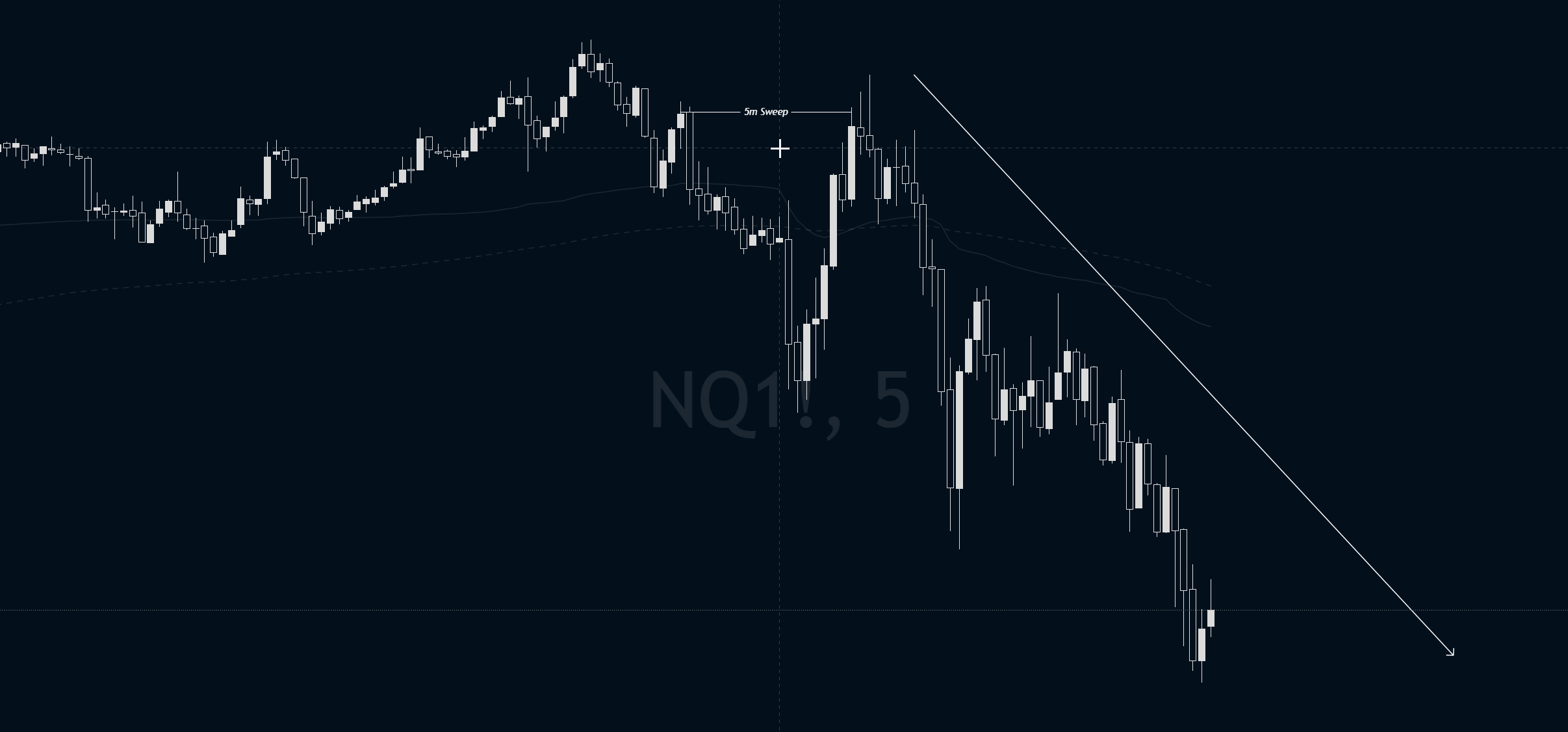
A sweep looks like this in real-time:
- Price approaches one of your mapped levels — say the Previous Day High
- It pushes through that level by a few points
- Long wicks start forming above PDH as buy stops trigger
- Within 1–3 candles, price reverses back below PDH
The key characteristic: price exceeds the level but doesn't hold. It pierces, triggers the resting orders, and snaps back. On a 5-minute chart, this typically shows as a candle (or cluster of candles) with wicks above the level but bodies closing below it.
What you're not looking for: price breaking cleanly through a level and continuing. That's a breakout, not a sweep. Sweeps are defined by the reversal — the rejection after the raid.
Step 4: Confirm the Reversal Candle
After price raids the liquidity level, you need to see a decisive reversal candle:
- For a bearish sweep (price swept above a high): Look for a candle that closes with a full body back below the swept level. Not a doji, not a spinning top — a candle with directional intent.
- For a bullish sweep (price swept below a low): Look for a candle that closes with a full body back above the swept level.
The body close matters. Wicks can be deceiving. A candle that wicks below a level but closes above it hasn't confirmed anything yet.
Step 5: Check for the Follow-Through Setup
A sweep alone isn't a trade. It's the first gate.
After confirming the sweep, the LSTrades methodology looks for an iFVG (inverted Fair Value Gap) — a price imbalance that forms on the reversal and then gets re-entered from the opposite side. The sweep provides the context (liquidity was taken), and the iFVG provides the precise entry point.
If no iFVG forms after the sweep, there's no trade. This filter is what separates signal from noise.
Common Mistakes When Identifying Sweeps
Calling every wick a sweep. A candle wicking past a level by 0.25 points during low volume isn't a sweep. Genuine sweeps clear the level enough to trigger the cluster of stops — you'll see it in the speed and aggression of the move.
Ignoring session context. A sweep of the Previous Day High at 3:00 AM EST (London session) doesn't carry the same institutional weight as the same sweep at 9:45 AM EST. Time matters.
Looking for sweeps at random levels. If nobody has their stops at a particular price, sweeping it means nothing. Focus on the levels where orders actually cluster: session extremes, prior day extremes, and obvious double-tops/double-bottoms.
Forcing a trade after every sweep. Not every sweep leads to a clean reversal. Sometimes price sweeps a level and chops. The iFVG filter exists precisely for this reason — if the market doesn't produce a clean entry structure after the sweep, there's no signal.
Putting It Together
The checklist:
- Before the session: map PDH, PDL, overnight extremes, session pivots, equal highs/lows
- During the NY AM session (focus on 9:45–11:00 AM EST): watch for price approaching these levels
- When price pierces a level: watch for the reversal candle (body close back through)
- After the reversal: look for the iFVG formation
- If iFVG inverts: that's a valid setup
This is the exact sequence the LSTrades indicator automates. Every signal that fires in Discord has passed all five of these gates.
New to the methodology? Start with What Is a Liquidity Sweep? for the conceptual foundation, then What Is an iFVG? for the entry mechanism. Or join the LSTrades Discord to watch these setups fire live.
Want to sit in the room?
Trade NQ live with me every NY open.
Pre-market read, the entry called as price gets there, full debrief after. You watch the read, not just the result.