
Fair Value Gaps vs Inverted Fair Value Gaps: What's the Difference?
Fair Value Gaps are one of the most discussed concepts in ICT trading. But there's a critical distinction that trips up a lot of traders: the difference between a regular FVG and an inverted FVG (iFVG).
They look similar on a chart. They involve the same three-candle structure. But they mean different things — and in the LSTrades system, only one of them triggers a trade.
Here's the difference.
What Is a Fair Value Gap (FVG)?
A Fair Value Gap is a price imbalance created by a strong directional candle. It's defined by three consecutive candles where the middle candle moves so aggressively that there's no overlap between the wicks of candles 1 and 3.
Bullish FVG:
- Candle 1 has a high (upper wick)
- Candle 2 is a strong bullish candle (big displacement up)
- Candle 3 has a low (lower wick) that is above candle 1's high
- The gap between candle 1's high and candle 3's low is the FVG
Bearish FVG:
- Candle 1 has a low (lower wick)
- Candle 2 is a strong bearish candle (big displacement down)
- Candle 3 has a high (upper wick) that is below candle 1's low
- The gap between candle 1's low and candle 3's high is the FVG
The gap itself represents inefficiency. Price moved so fast that it didn't fully "auction" through that zone. Institutional theory says price tends to return to fill these gaps before continuing — which is why traders watch them as potential support and resistance zones.
On a 5-minute NQ chart, FVGs form constantly. They show up during session opens, around news events, and whenever institutional order flow creates displacement. Most of them get filled (mitigated) quickly. Some persist and become relevant later.
What Makes an FVG "Inverted"?
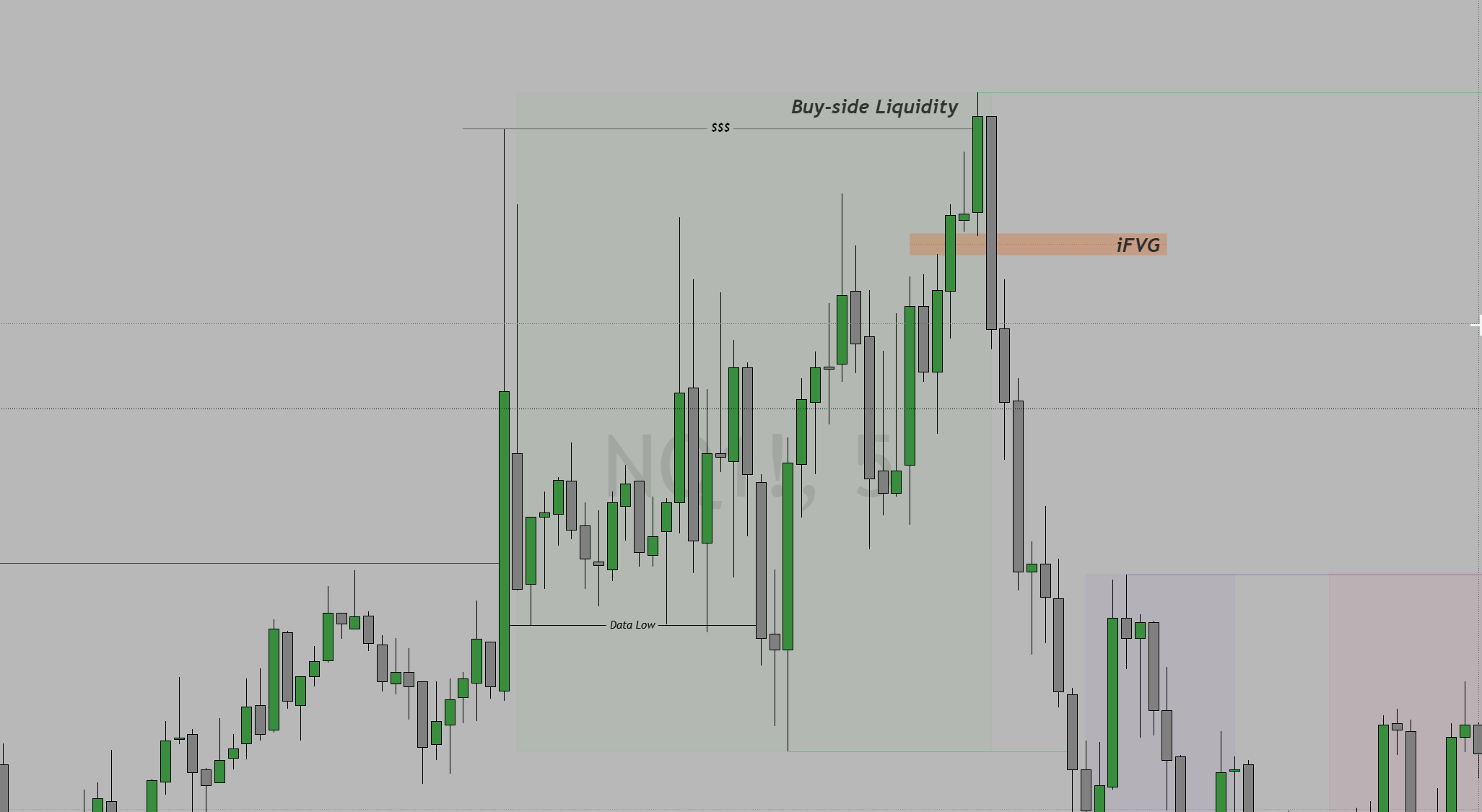
An FVG becomes an inverted Fair Value Gap (iFVG) when price re-enters the gap from the opposite side.
The sequence:
- A bullish FVG forms — price gapped up, leaving an imbalance below
- Price continues higher for a while
- Price then retraces and comes back down into the FVG zone
- When price enters from the top (the opposite side of the original direction), the FVG has been inverted
For a bearish iFVG, it's the mirror: a bearish FVG forms, price continues lower, then retraces up into the gap from below.
The inversion is the key event. The FVG was originally a support zone (bullish) or resistance zone (bearish). When price approaches it from the other side, the role flips. What was support becomes resistance. What was resistance becomes support.
Why the Distinction Matters
A regular FVG is a zone. It tells you where an imbalance exists. Traders might watch it for a retracement — "price will come back to fill this gap." That's useful context, but it's not precise enough for a signal.
An iFVG is an event. It tells you that the market created an imbalance, moved away from it, and then returned to that exact zone from the opposite direction. This is specific. It happens at a defined moment on a defined candle.
In the LSTrades system:
- FVGs on higher timeframes (15m, 1H, 4H) are tracked as zones — they provide context for grading. If a liquidity sweep drives price into an HTF FVG zone, the signal gets a higher grade.
- iFVGs on the chart timeframe are the entry trigger — when price inverts an FVG after a liquidity sweep, that's the signal. Entry, stop loss, and take-profit levels are all derived from that inversion.
FVGs inform. iFVGs execute.
Visual Example
Visual Comparison
Regular FVG (zone)
Candle 1:  ─── high wick
Candle 2:  ═══ STRONG MOVE UP ═══
Candle 3:  ─── low wick (above candle 1 high)

Gap = between candle 1 high and candle 3 low
Role: potential pullback zone (price may return to fill it)
Inverted FVG (event)
Same gap exists...
Price moved away...
Now price comes BACK INTO the gap from the OTHER SIDE

Role: entry trigger — the zone has been re-tested from the opposite direction
The regular FVG sits there waiting. The iFVG happens when price interacts with it in a specific way.
How the LSTrades System Uses Both
FVGs (Higher Timeframe Zones)
The indicator scans for Fair Value Gaps on three higher timeframes: 15-minute, 1-hour, and 4-hour.
- Up to 10 zones tracked per timeframe
- Zones are drawn on the chart as colored boxes
- A zone is removed when price fully fills (mitigates) it
- Role in grading: If a liquidity sweep drives price into one of these HTF FVG zones, the signal is upgraded. This is the HTF FVG alignment factor that contributes to A+ and A++ grades.
These are context zones. They tell you where institutional-level imbalances exist. A sweep into one of these zones carries more weight than a sweep at a random level.
iFVGs (Chart Timeframe Entry Trigger)
The indicator detects iFVG inversions on the chart timeframe (typically 5-minute):
- Only fresh iFVGs count — gaps older than 10 bars are ignored
- The gap must be wide enough relative to recent volatility (ATR-based filter)
- The inversion must happen within 10 candles of the liquidity sweep
- Role: This is the entry. When the iFVG inverts, the signal fires.
The iFVG defines everything about the trade:
- Entry: The price where the inversion candle enters the FVG zone
- Stop loss: Just beyond the opposite edge of the FVG zone
- Take-profit targets: Calculated as multiples of the SL distance (1R for TP1, 2R for TP2)
Common Confusions
"I see an FVG — is that a signal?" No. An FVG is a zone, not a signal. The signal requires a sweep first, then the FVG must invert (become an iFVG). Without the sweep context and the inversion event, there's no trade.
"Can an FVG become an iFVG on any timeframe?" In the LSTrades system, iFVGs are detected on the chart timeframe. Higher-timeframe FVGs serve a different role — they're zones for grading, not entry triggers.
"What if the FVG gets filled before it inverts?" If price trades completely through the FVG zone (filling the gap), it's mitigated. A mitigated FVG can't invert — the imbalance has been resolved. The indicator removes these automatically.
"Do all iFVGs lead to good trades?" No. The iFVG is one gate. It must be preceded by a liquidity sweep, occur within the NY AM session, and pass volatility filters. The grading system then tells you how much additional confluence supports the setup.
The Full Hierarchy
Here's how FVGs and iFVGs fit into the complete signal system:
- HTF FVGs (4H, 1H, 15m) → Institutional imbalance zones → Used for grading
- Liquidity sweep → Price raids a key level during the NY AM session → First gate
- Chart-timeframe FVG → Displacement candle creates an imbalance → Setup forming
- iFVG inversion → Price re-enters that FVG from the opposite side → Signal fires
- Grade assigned → Based on sweep location, HTF FVG alignment, CISD, BPR, MTF trend
FVGs set the stage. The iFVG pulls the trigger.
Deep-dive into each component: What Is a Liquidity Sweep? covers the first gate, What Is an iFVG? explains the entry mechanism in detail, and How to Grade Trade Setups breaks down what earns each grade. Or join the free Discord and watch FVGs and iFVGs play out on live NQ charts.
Want to sit in the room?
Trade NQ live with me every NY open.
Pre-market read, the entry called as price gets there, full debrief after. You watch the read, not just the result.